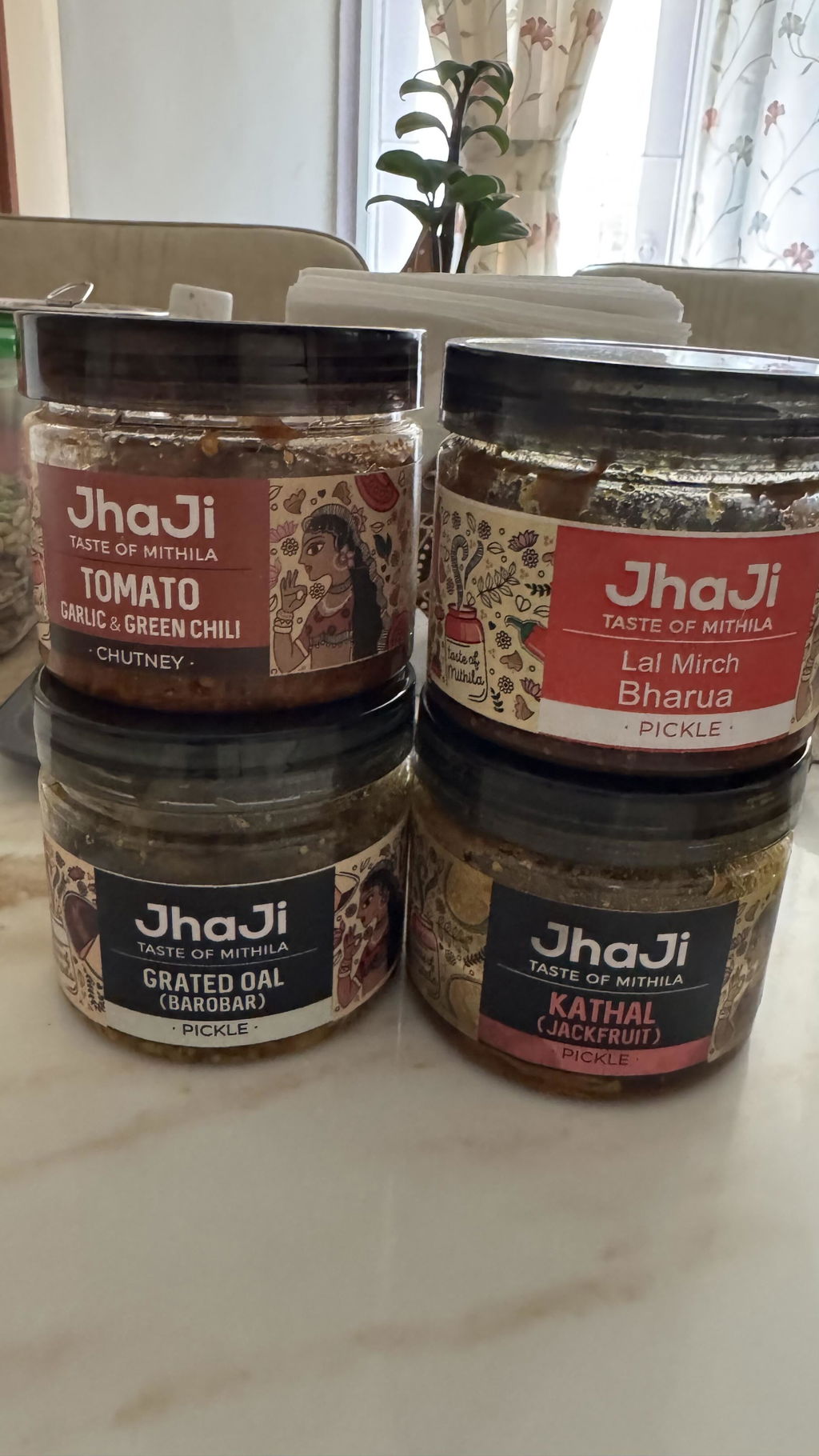
In Bihar, winter is when pickle jars move closer — from shelves to the dining mat.
This selection brings together four winter preparations that sit at the heart of how food is eaten across Bihar during the colder months.
In many homes, winter is when pickle jars move closer — from shelves to the dining table, from storage to daily use.
Vegetables are at their best, sunlight is gentle but steady, and recipes that require patience — such as stuffing, steaming, grating, and slow sun-maturation — finally belong.
These are not year-round pickles.
And they are not recipes meant to be rushed.
Each one is traditionally prepared only during winter, using methods passed down through generations of women in Mithila and nearby regions.
Different kitchens may adjust spice levels or proportions.
But the core methods remain unchanged.
This is winter food made the way it has always been.
Lal Mirch Bharua Pickle
The centrepiece of the winter table

Each chilli is deseeded and stuffed by hand — a slow process that defines a true Bharua pickle.
Among all winter pickles in Bihar, Lal Mirch Bharua holds a special place.
Thick, tender red chillies are selected for their ability to hold masala without tearing, soften naturally during maturation, and retain their shape even after months in the jar.
The chillies are washed, lightly sun-dried, and then carefully emptied of their seeds by hand, not torn or slit forcefully.
The seeds are not discarded. They are mixed back into a coarse masala made with roasted mustard seeds, coriander, cumin, fenugreek, ajwain, and mustard oil.
Each chilli is then stuffed one at a time.

Sun-matured over several winter days, allowing the chilli to soften and the masala to settle.
After stuffing, the chillies are laid out gently on traditional bamboo trays (सूप) and kept under the winter sun.
Over several days of sunlight, the chilli softens, the masala settles, and the flavours round out — bold, savoury, and never harsh.
This is the pickle that appears most often on winter plates across Bihar.
Taste: Masaledar, bold, not oily
Ingredients: Red Chilli, Mustard Seeds, Black Mustard, Coriander Powder, Cumin, Carom Seeds, Fenugreek, Nigella Seeds, Turmeric, Red Chilli Powder, Amchoor, Black Salt, Salt, and Mustard Oil.
Traditionally eaten with: Dal–chawal, dahi–choora, poori–bhujia
Jackfruit (Kathal) Pickle
A vegetable pickle that eats like a meal

Jackfruit pickle is prepared only when raw kathal is available at the right stage — neither too young nor over-mature.
The fruit is cut into pieces and lightly steamed before pickling.
This step is essential and cannot be skipped.
Steaming softens the kathal just enough to help it absorb spices while retaining its meaty texture.
After steaming, the pieces are marinated with salt and turmeric and left untouched so the moisture releases naturally.
Only then are hand-ground spices, mustard oil, amchoor, and black salt added.
The pickle is sun-dried slowly over several days until the jackfruit absorbs the masala fully.
In many homes, this pickle replaces a vegetable on the plate — especially on days when meals are simple.
Taste: Hearty, spicy-tangy, deeply satisfying
Ingredients: Jackfruit, Mustard Oil, Turmeric, Red Chilli Powder, Coriander Powder, Cumin, Nigella Seeds, Carom Seeds, Fenugreek, Fennel Seeds, Yellow Mustard, Black Mustard, Asafoetida, Aamchoor, Black Salt, Salt.
Traditionally eaten with: Roti–sabzi, dal–chawal, khichdi
Oal Barobara Pickle
Grated, rustic, and deeply comforting

Oal Barobara is a traditional grated pickle prepared using equal quantities of oal (jimkand), ginger, and green chilli.
The ingredients are grated finely — never chopped — exactly as it is done in homes across Darbhanga and nearby districts.
The mixture is first marinated with salt, turmeric, and lemon juice and left untouched.
This resting period allows the natural moisture to release, which is essential to the final texture and flavour.
Only after this stage are mustard oil and spices added.
This pickle is not meant to sit on the side of the plate.
It is meant to mix into food — folded into rice, pressed into roti, or stirred into khichdi. That is where it belongs.
Taste: Tangy, gingery, gently spicy
Ingredients: Oal (Jimikand/ Suran), Crushed Green Chilli, Ginger, Lemon Juice, Amchoor, Mustard Oil, Mustard, Coriander Powder, Cumin, Carom Seed, Fenugreek, Fennel Seeds, Black Cumin Seeds. Nigella Seeds. Turmeric, Asafoetida, Black Salt, and Salt.
Traditionally eaten with: Plain roti, khichdi, dal–rice
Tomato Garlic Chutney
A winter chutney built to last
This is not a fresh chutney meant for immediate consumption.
It is a pickled winter chutney, prepared with ingredients that require balance and structure to mature well over time.
Tomato, being a fruit with naturally high water content, cannot be preserved safely or consistently using oil and salt alone.

In traditional kitchens, fruit vinegar is added not as a shortcut, but as a necessity — to stabilise the chutney, protect it over time, and allow its flavours to develop without spoilage.
Ripe tomatoes are chopped along with peeled garlic, ginger, and chillies.
They are slow-cooked with spices, mustard oil, and fruit vinegar until the rawness disappears and the chutney begins to settle.
Sun-maturation then does its work.
Over time, the vinegar softens the sharpness of garlic, the tomato develops a clean tang without sweetness, and the chutney gains a rounded, well-integrated depth rather than a harsh sour note.
This balance is what allows the chutney to keep well and taste better with age. A small quantity is enough to wake up a simple meal.
Taste: Chatpata, garlicky, tangy
Ingredients: Tomato, Garlic, Ginger, Green Chili, Vinegar, Salt, Yellow Mustard, Turmeric, Fenugreek, Curry Leaves
Traditionally eaten with: Parathas, snacks, dal–chawal, evening tiffins
How These Pickles Are Made

The methods followed here are the same ones used at home.
✔️ Sun-dried over days, not hours
✔️ Whole spices roasted and ground in-house
✔️ Mustard oil used as the natural preservative
✔️ Stored and matured in glass martabaans
No artificial preservatives.
No artificial colour.
Note that the tomato chutney uses fruit vinegar, made essential because of Tomato’s high water content.
Winter pickles take time.
And we do not rush them.
Storage & Usage
✔️ Always use a clean, dry spoon
✔️ Keep jars tightly closed
✔️ Store in a cool, dry place
Slight darkening over time is natural and expected.
It is a result of mustard oil, spices, and sun-maturation.
Shelf life: 18 months from the date of manufacturing for the 3 pickles, 12 months for the Tomato Chutney
Who This Is For

This selection is for those who want to understand how winter pickles are actually eaten in Bihar.
For those who enjoy variety across meals — not one flavour repeated again and again.
And for those gifting someone a true taste of Bihar’s winters, made the way it has always been.
This is not an experiment.
It is a collection of the pickles people return to — year after year.
A Quiet Place to Begin
If you’ve been meaning to try JhaJi Store, this is an honest place to begin.
Frequently Asked Questions (FAQ)
Are all the pickles in this pack made during winter?
Yes.
All four preparations included here — Lal Mirch Bharua, Jackfruit Pickle, Oal Barobara, and Tomato Garlic Chutney — are traditionally made during the winter months.
This is when:
✔️ Raw materials are at their best
✔️ Sunlight is gentle and consistent
✔️ Slow processes like stuffing, steaming, grating, and sun-maturation make sense
These recipes are not meant for year-round production.
Is Tomato Garlic Chutney a pickle or a chutney?
It is a pickled chutney.
Unlike fresh chutneys meant to be eaten immediately, this chutney is:
✔️ Slow-cooked
✔️ Made with mustard oil
✔️ Sun-matured over days
That process allows it to keep well and develop a deeper flavour over time — much like a pickle.
Why does the Tomato Garlic Chutney contain vinegar?
Because tomato is a fruit with high natural moisture, it cannot be preserved safely using oil and salt alone.
In traditional pickling, fruit vinegar is used deliberately to stabilise such chutneys, protect them over time, and allow the flavours to mature without spoilage.
The vinegar used here is not a shortcut or preservative substitute — it is an essential part of the recipe.
It also adds balance, helping the garlic mellow and the tomato develop a clean, rounded tang rather than sharp sourness.
This is why the chutney keeps well and tastes better as it settles.
Are these very spicy?
They are boldly flavoured, not aggressively spicy.
Each item has a different heat profile:
✔️ Lal Mirch Bharua builds heat slowly and feels rounded
✔️ Jackfruit Pickle is hearty and balanced
✔️ Oal Barobara is tangy and gently spicy
✔️ Tomato Garlic Chutney is sharp and chatpata
Most customers describe the experience as strong but balanced, not burning.
Do all the pickles contain garlic?
No.
Only the Tomato Garlic Chutney contains garlic.
The three pickles — Lal Mirch Bharua, Jackfruit Pickle, and Oal Barobara — are made without garlic or onion, following traditional methods.
Can I eat these every day?
Yes — and that is how they are traditionally used.
These are not novelty pickles meant for occasional tasting.
In Bihar, they are eaten:
✔️ In small quantities
✔️ Across daily meals
✔️ Mixed into food rather than piled on the side
Because the flavours are deep and concentrated, a little goes a long way.
Why do the pickles darken over time?
Natural darkening is expected and normal.
It happens due to:
✔️ Mustard oil
✔️ Roasted spices
✔️ Sun-maturation
This is a sign of traditional preparation, not spoilage or added colour.
Is oil separation normal?
Yes.
Mustard oil naturally settles over time and acts as a preservative.
If you notice oil at the bottom or top of the jar, simply stir gently before serving.
How should these be stored once opened?
✔️ Always use a clean, dry spoon
✔️ Close the lid tightly after use
✔️ Store in a cool, dry place
Avoid moisture entering the jar.
Handled this way, the pickles keep well for months.
What if I don’t like one flavour in the pack?
That’s normal.
Different people gravitate toward different flavours.
This selection is meant to give variety across meals — not to be eaten in equal quantities.
Most customers find that one or two favourites emerge naturally over time.
Is this suitable for gifting?
Yes.
This is a thoughtful choice for:
✔️ People who miss the food of Bihar
✔️ Families who value traditional preparation
✔️ Anyone who enjoys variety across meals
It reflects everyday winter food, not novelty packaging.
Why do customers keep coming back to this pickle?
Because they taste familiar, consistent, and properly made.
They are prepared the slow way, using methods people recognise from home.
That trust — more than novelty — is why these remain among the most reordered items at JhaJi Store.
Lal Mirch ka Bharua Achar or Stuffed Red Chilli Pickle is sold as part of Mithila Pickles , Spicy Pickles and All Pickle Collection on JhaJi Store.